
The short answer: a kitchen renovation in Auckland costs between $15,000 and $90,000+ in 2026, depending on layout complexity, material selections, and whether you are relocating plumbing or electrical services. A mid-range kitchen renovation for a typical three-bedroom Auckland home sits between $25,000 and $50,000.
Those ranges mean nothing without context. A homeowner replacing cabinet fronts in a galley kitchen is not in the same conversation as someone gutting a villa kitchen to create an open-plan living space with a waterfall island bench. The costs are different because the work is different.
This guide breaks down actual 2026 kitchen renovation costs in Auckland from a quantity surveying perspective. Our in-house QS team prices kitchen projects weekly, so these numbers reflect real tender pricing, not generic national averages or outdated data pulled from 2021 articles. If you are sizing your budget before committing to a kitchen renovation, this is where you start.
Get a quick estimate for your kitchen renovation:
Use our free online estimate tool
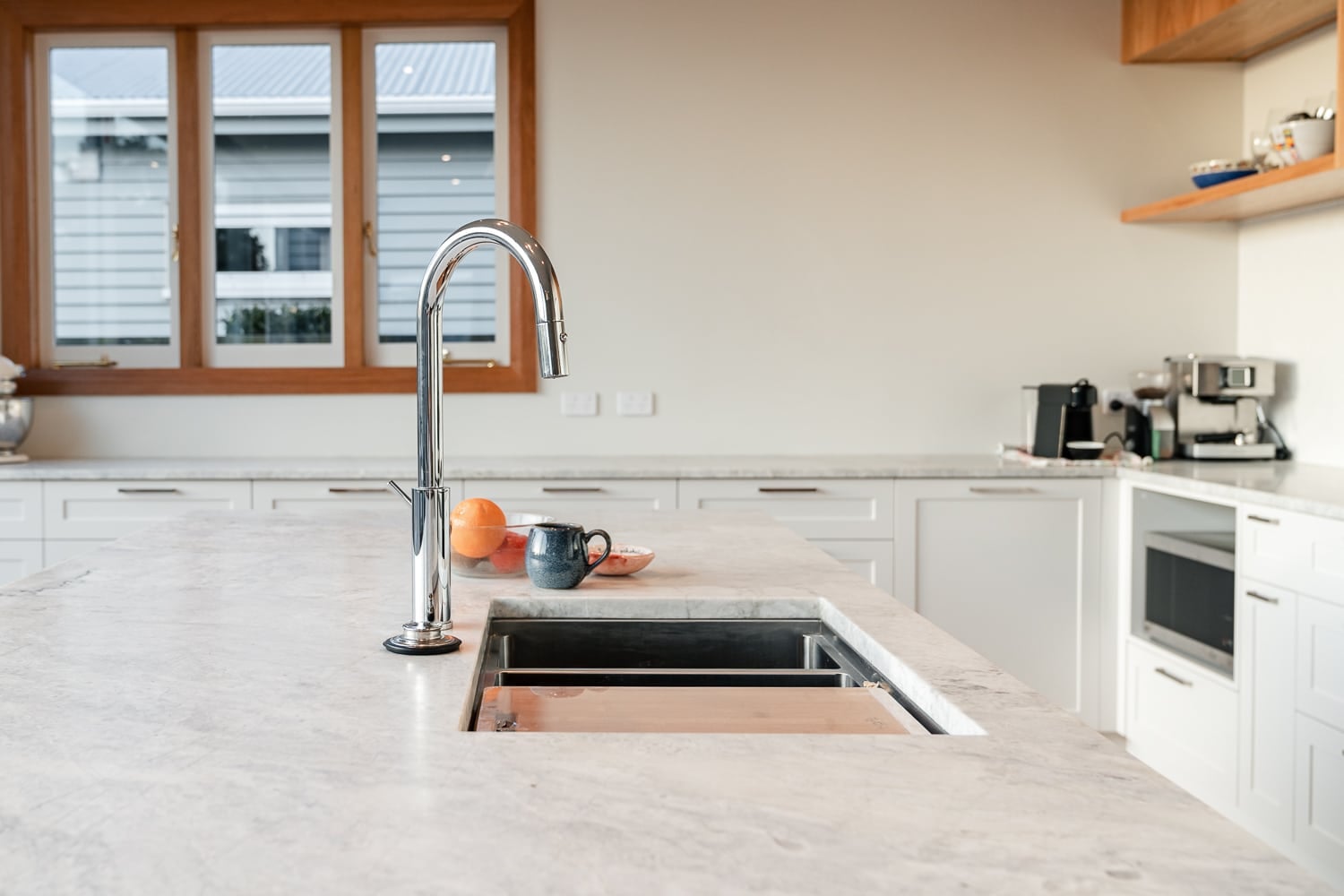
What Do Kitchen Renovations Cost in Auckland in 2026?
Kitchen renovation costs in Auckland fall into three broad tiers. The table below reflects current pricing from our QS team for Auckland residential projects tendered between January and August 2026.
| Tier | Cost Range | What You Get |
| Budget | $15,000–$25,000 | New cabinetry (flat-panel melamine), laminate benchtops, existing layout retained, appliance upgrade, new splashback, repaint. No plumbing or electrical relocation. |
| Mid-range | $25,000–$50,000 | Custom cabinetry (painted MDF or plywood), engineered stone benchtops, new lighting plan, minor layout changes, upgraded appliances, tiled splashback, new flooring within kitchen footprint. |
| High-end | $50,000–$90,000+ | Bespoke joinery (solid timber or two-pack polyurethane), natural stone or porcelain benchtops, full layout reconfiguration, island bench, premium integrated appliances, underfloor heating, structural changes (wall removal), new electrical board upgrade. |
Most Auckland homeowners we work with land in the mid-range tier. They want a genuine transformation, not just a cosmetic refresh, but they are not chasing commercial-grade fitouts or architect-designed showpieces.
What Drives Kitchen Renovation Costs in Auckland?
Six factors determine where your kitchen project lands on the cost spectrum. Understanding these helps you make trade-offs that keep the budget where you want it.
Cabinetry (35% of total cost)
Cabinetry is the single biggest line item in any kitchen renovation. In Auckland, you are choosing between:
- Flat-pack or imported melamine cabinets: $4,000–$8,000 installed. Functional but limited in configuration and finish quality. Standard 10-year lifespan before doors sag or delaminate.
- Custom melamine or MDF cabinetry (local joiner): $8,000–$18,000 installed. Built to your exact dimensions, better hardware (soft-close Blum or Hettich hinges), wider colour and profile options.
- Bespoke painted or timber cabinetry: $18,000–$35,000+ installed. Solid timber frames, two-pack polyurethane or hand-painted finishes, fully custom internals (pull-out pantry systems, corner carousels, integrated bins).
The jump from imported flat-pack to a local custom joiner is where most Auckland homeowners see the biggest quality-to-cost improvement. You get cabinetry engineered for your space rather than adapted from standard modules.
Benchtops (15% of total cost)
Benchtop pricing in Auckland varies dramatically by material:
- Laminate: $800–$2,500 for the entire kitchen. Durable, budget-friendly, limited edge profiles.
- Engineered stone (Caesarstone, Smartstone, Essastone): $3,000–$7,000. The most popular mid-range choice in Auckland. Consistent colour, non-porous, 15-year warranty.
- Natural stone (granite, marble): $5,000–$12,000. Premium look, requires sealing, and each slab is unique.
- Porcelain slab (Dekton, Neolith): $6,000–$15,000. Ultra-thin, heat-resistant, UV-stable, and growing fast in Auckland high-end kitchens.
Benchtop costs are driven by linear metres, edge detailing, cutouts (sink and cooktop), and whether you need waterfall ends on an island bench. A 3-metre straight run is a different proposition from a 6-metre L-shape with a 2.4-metre island.
Appliances (20% of total cost)
Appliance budgets range from $3,000 for a basic Fisher & Paykel package to $25,000+ for an integrated Miele or Gaggenau suite. The mid-range sweet spot in Auckland is $6,000–$12,000 for a quality package:
- Induction cooktop: $1,500–$4,000
- Built-in oven: $1,200–$5,000
- Integrated rangehood: $800–$3,500
- Integrated dishwasher: $1,200–$3,000
- Fridge (panel-ready): $2,500–$8,000
Appliances are one area where you can phase spending. Install the cabinetry with standard appliance openings, then upgrade individual items over time without touching the kitchen structure.
Plumbing Relocation (variable)
If your new layout keeps the sink where it is, plumbing costs are minimal ($500–$1,500 for new tapware and waste connection). Moving the sink to an island or different wall adds $3,000–$8,000 for new pipe runs, waste drainage, and potentially a pump if the new position is far from the stack.
Relocating a dishwasher adds $500–$1,500 depending on distance from existing services.
Electrical Upgrade (variable)
Older Auckland homes (pre-1990) often have a 60-amp board that cannot handle a modern kitchen's electrical load. Budget for:
- Electrical board upgrade: $2,500–$5,000 if required
- New circuits and GPOs: $1,500–$4,000 depending on how many power points and dedicated circuits are required
- LED lighting plan: $1,000–$3,500 for under-cabinet, pendant, and recessed lighting
Do not underestimate electrical costs. A kitchen with an induction hob, instant hot water tap, integrated coffee machine, and multiple small-appliance stations can require six to eight dedicated circuits.
Layout Changes and Structural Work
If you are opening up a wall to connect kitchen and living areas, structural engineering and building consent enter the picture:
- Load-bearing wall removal (steel beam): $5,000–$15,000
- Building consent (Auckland Council): $2,000–$4,500
- Engineer's PS1 design and PS4 producer statement: $2,000–$4,000
Layout changes multiply the overall project cost because they involve consents, engineering, plastering, painting, and flooring transitions that go well beyond the kitchen itself.
Where Does Your Kitchen Renovation Budget Actually Go?
JRA's quantity surveying team tracks cost allocation across kitchen projects. Here is where money typically lands on a mid-range Auckland kitchen renovation ($35,000–$45,000 project):
| Category | % of Budget | Dollar Range |
| Cabinetry and joinery | 35% | $12,000–$16,000 |
| Benchtops | 15% | $5,000–$7,000 |
| Appliances | 20% | $7,000–$9,000 |
| Plumbing | 8% | $2,800–$3,600 |
| Electrical | 8% | $2,800–$3,600 |
| Flooring | 5% | $1,750–$2,250 |
| Tiling / splashback | 4% | $1,400–$1,800 |
| Labour (installation) | 5% | $1,750–$2,250 |
This breakdown shifts on high-end projects where bespoke joinery and premium appliances consume a larger share. On budget projects, appliances and cabinetry still dominate, but everything scales down proportionally.
The value of seeing this breakdown is simple: if your quote comes back higher than expected, you know exactly which category to interrogate. If cabinetry is 50% of your quote, something is off, or the joinery specification is significantly above mid-range.
What Hidden Costs Do Most Auckland Homeowners Miss?
These costs are not hidden in the sense that builders are concealing them. They are hidden because homeowners do not think to budget for them until the project is underway.
Building consent fees
If your renovation involves structural changes, plumbing relocation, or altering the building envelope, you need building consent from Auckland Council. Fees typically sit between $2,000 and $4,500 depending on project value and complexity. Processing time is statutorily 20 working days, though Auckland Council regularly exceeds that.
Asbestos testing and removal
Pre-1990 Auckland homes may have asbestos in textured ceilings, old vinyl flooring underlay, or fibrous cement backing boards behind tiles. Testing costs $300–$600. Removal, if required, costs $2,000–$8,000 depending on extent and access.
Temporary kitchen setup
You will not have a functioning kitchen for 3–6 weeks during renovation. Budget $500–$1,500 for a temporary setup, or factor in increased takeaway and dining costs.
Waste removal and site preparation
Demolishing an old kitchen generates 2–4 cubic metres of waste. Skip bin hire usually costs $350–$600. If the old kitchen has plaster over brick, demolition is slower and more expensive than removing modern plasterboard.
Flooring transitions
If you are replacing kitchen flooring, it needs to transition cleanly into adjoining rooms. That often means extending new flooring into hallways or living areas for a seamless finish, which adds $1,500–$4,000 depending on material and area.
Ready to price your kitchen renovation?
Get a free estimate in under 2 minutes
How to Avoid a Kitchen Renovation Budget Blowout
Budget blowouts on kitchen renovations are almost always caused by scope creep, not contractor incompetence. Here is how to protect your budget:
Lock your selections before signing the contract
Every “TBC” item in your contract is a future variation. Choose your benchtop material, appliance models, tapware, handles, tile, and paint colour before signing. Provisional sums and allowances are budget risks disguised as flexibility.
Do not change the layout unless you have budgeted for consent
The moment you move plumbing, remove a wall, or shift the cooktop location, you are likely triggering a building consent requirement. That can mean $4,000–$8,000 in consent fees, engineering, and processing time before any physical work changes. Decide layout first, then budget.
Get a fixed-price contract
Cost-plus contracts remove all incentive for the builder to control costs. A fixed-price contract with a clearly defined scope is the safest way to protect your budget. If the scope does not change, the price does not change.
Hold 10% contingency separately
Even with a fixed-price contract, you may initiate variations. Keep 10% of your total budget in reserve for decisions you have not made yet. On a $40,000 kitchen, that is $4,000 set aside.
Kitchen Renovation Cost FAQs
How long does a kitchen renovation take in Auckland?
A straightforward kitchen renovation with no structural changes and no consent required typically takes 3–5 weeks from demolition to completion. If you are removing walls, relocating services, or waiting on Auckland Council consent, add another 4–8 weeks to the programme. The biggest delay factor is usually cabinetry lead time, with custom joinery in Auckland currently running 6–10 weeks from sign-off to delivery.
Can I renovate my kitchen for under $20,000?
Yes, if you keep the existing layout, retain existing plumbing and electrical positions, and choose budget materials such as melamine cabinetry, laminate benchtops, and standard appliances. This is a cosmetic refresh rather than a full renovation, but it can dramatically improve a tired kitchen's appearance.
Do I need building consent for a kitchen renovation in Auckland?
Not always. If you are replacing cabinetry, benchtops, appliances, and finishes without moving plumbing, altering structure, or changing the building envelope, consent is usually not required. The moment you relocate plumbing, remove load-bearing walls, or alter drainage, consent is needed. If you are unsure, check with Auckland Council's duty planner before committing.
Is it cheaper to renovate or replace a kitchen?
Renovating by refacing cabinets, replacing benchtops and handles, and keeping the layout can cost $8,000–$15,000. A full replacement with potential layout change generally costs $25,000–$90,000+. The decision depends on whether the existing carcasses are structurally sound and whether you are happy with the current layout.
What is the most expensive part of a kitchen renovation?
Cabinetry and joinery, consistently. It accounts for around 35% of a typical Auckland kitchen project. On high-end kitchens with bespoke joinery, it can reach 40–45%. Appliances are typically second at 20%, followed by benchtops at 15%.
What to Do Next
If you are ready to get accurate pricing for your kitchen renovation, contact us for a free initial consultation where we assess your existing kitchen, discuss your goals, and provide an indicative cost range based on your specific scope.
Related reading:
Authority sources referenced: