
Most homeowners start their renovation or new build journey obsessing over kitchen islands, open-plan living, and bathroom tiles.
This is a mistake.
While the interior dictates how you live in the home, the custom home exterior design dictates whether the project is even possible. The exterior determines if the Auckland Council will approve your consent, if the structure will survive New Zealand’s humid coastal climate, and if the groundworks will bankrupt your budget before a single wall goes up.
If you are planning a major custom build in Auckland, you likely have three specific fears keeping you up at night:
- Topography: Will building on my sloping site blow the budget?
- Aesthetics: Will the extension look like a cheap “stuck-on” box that ruins the character of my home?
- Durability: Will this home rot like the plaster homes of the 90s?
You are right to be worried. These are the three areas where costs spiral and timelines blow out.
In this guide, we answer those questions honestly. We explain the specific costs of building on Auckland’s volcanic slopes, the engineering behind rot prevention, and the design rules that keep your home looking cohesive.
(Note: This guide focuses specifically on the exterior feasibility phase. For a complete roadmap of the entire building process from concept to completion, read our Ultimate New Build Guide).
How Much Does It Actually Cost to Build on a Sloping Site in Auckland?
If you own a flat section in Auckland, count yourself lucky. Most of the region—from the Waitākere ranges to the bays of the North Shore—is built on ridges, gullies, and volcanic cones.
A common question we hear during initial consults is: “Why is the quote for my sloping site $50,000 higher than my friend’s build on the flat?”
We need to address the cost issue immediately. Building on a significant slope in Auckland typically adds 15% to 25% to your foundation and groundworks budget compared to a flat site. This money does not buy you a nicer kitchen; it simply gets you out of the ground.
The Three Hidden Cost Drivers of Slopes
It is not just about “difficulty.” There are three specific technical factors that drive up the price of custom home construction on a hill.
1. Earthworks (Cut and Fill)
You cannot build a stable home on a 20-degree slope without creating a flat platform or bench. This requires “cutting” into the bank and “filling” other areas.
This process triggers several costs:
- Heavy Machinery: We need diggers, not just shovels.
- Tipping Fees: The clay and soil we remove cannot vanish. It must be trucked to a managed fill site. In Auckland, tipping fees are high and charged by weight.
- Sediment Control: To comply with council rules, we must install silt fences and hay bales to prevent runoff into stormwater drains.
2. Retaining Walls
Once you cut the earth, you must hold it back. Retaining walls are not “landscaping”; they are structural engineering.
- Timber Pole Walls: These are generally the most cost-effective solution for moderate heights.
- Concrete Block Walls: For higher cuts or cuts close to boundaries/driveways, we often need reinforced concrete block. This requires steel reinforcing and concrete filling, which significantly increases the price per linear metre.
- Palisade Walls: On unstable ground or cliff-top sites, we may need inground palisade walls to stop the land itself from sliding.
3. Access and Logistics
Gravity works against us on a slope. If a concrete truck cannot drive up your steep driveway to the building platform, we cannot pour the foundation directly.
- Concrete Pumps: We must hire boom pumps to transfer the concrete from the road to the site. This is a daily hire cost that flat sites rarely incur.
- Manual Handling: If a delivery truck cannot reach the site, builders must hand-carry timber, steel, and gib board. This adds hundreds of labour hours to the project timeline.
Getting Out of the Ground: Foundation Options
Your Geotechnical Report will dictate which foundation you need. You cannot price a custom home exterior design until you know what lies beneath the grass.
- Concrete Slab: Rarely an option on steep slopes without massive, expensive blockwork to create a level pod.
- Pole Foundations: Often the most cost-effective method for steep gradients. The house “floats” above the slope on timber or steel piles. This requires insulation under the floor but minimises earthworks.
- Stepped Foundations: This is the “Gold Standard” for design flow. The concrete floor steps down the hill, allowing the house to follow the contour of the land. It provides excellent indoor-outdoor flow but is technically complex to pour.
Comparison: Flat Site vs. Sloping Site Cost Drivers
To help you budget, here is how a sloping site changes the financial equation.
|
Cost Driver |
Flat Site Scenario |
Sloping Site Scenario |
Estimated Impact |
|
Foundation |
Standard Concrete Slab (“RibRaft”) |
Pole or Stepped Foundation |
High Increase |
|
Earthworks |
Minimal topsoil scrape |
Extensive Cut and Fill + Tipping Fees |
High Increase |
|
Retaining |
Garden edging (Landscaping) |
Structural Retaining Walls |
Major Cost |
|
Drainage |
Gravity connection to street |
May require pumps or detention tanks |
Moderate Increase |
|
Access |
Truck delivery to pad |
Concrete pumps + Scaffolding complexity |
Moderate Increase |
For a more detailed breakdown of building costs per square metre in the current market, review our guide on Construction Costs in Auckland.
WANT AN INSTANT ONLINE ESTIMATE?
Aesthetics: How to Avoid the ‘Stuck-On’ Extension Look
The second major pain point for clients is aesthetic anxiety. This is especially true for owners of Villas and Bungalows in heritage zones like Grey Lynn, Mt Eden, or Remuera.
The fear is that the new extension will look foreign—like a cheap box glued onto the back of a classic home.
We see this happen when designers focus on floor plan square footage but ignore the geometry of the existing house. To avoid this, your custom home exterior design must follow one of two proven strategies.
The Science of Architectural Continuity
If you ignore the geometry of your existing home, the addition will always look wrong.
- Roof Pitch: A bungalow typically has a roof pitch of 25 to 30 degrees. If you slap a flat-roof extension on the back without a transition, the clash jars the eye.
- Soffits and Eaves: Older homes have deep eaves (600mm+) with exposed rafters or tongue-and-groove soffits. This gives the house a “hat” that protects the walls. Budget designs often cut eaves back to 300mm or zero. This not only looks cheap but also exposes the cladding to more rain.
- Glazing Ratios: Heritage homes have “punched” windows (holes in the wall). Modern designs use floor-to-ceiling glass. A good design aligns the head heights of the new joinery with the old, creating a continuous horizontal line around the house.
Strategy 1: The Seamless Blend
This approach attempts to make the new extension indistinguishable from the original build.
- How it works: We match the weatherboard profile exactly (e.g., swapping from Rusticated to Bevelback is a common mistake to avoid). We source replica wooden joinery or high-end aluminium that mimics timber profiles.
- Best for: Heritage zones where street appeal is protected, or for homeowners who love the traditional aesthetic.
- The Cost: This is labour-intensive. Matching 100-year-old detailing requires high craft skill.
Strategy 2: The Intentional Contrast
This approach distinctly separates the old from the new.
- How it works: We might connect a white weatherboard Villa to a modern “pavilion” extension via a glass link corridor. The new section is clad in a contrasting material, such as dark vertical cedar or standing seam metal.
- Best for: Creating a clear visual break. It honours the history of the old house while acknowledging that the new kitchen/living area is a modern addition.
- The Benefit: Because you aren’t trying to match imperfect old carpentry, you can use modern, efficient materials without them looking out of place.
Durability: Preventing Rot in Auckland’s Coastal Climate
New Zealand has a painful history with “Leaky Buildings.” Many homeowners we speak to are terrified that their new custom build will rot ten years down the line.
This fear is valid. Auckland is humid, coastal, and prone to horizontal rain.
To guarantee rot prevention, the material selection in your exterior design is critical. We specifically recommend looking at light-gauge steel framing options.
Timber vs. Steel Framing
- The Problem with Timber: Timber is organic. It absorbs moisture. If a pipe leaks or a window flashing fails, wet timber creates the perfect environment for mould and borer. Over time, this structural rot can compromise the home.
- The JRA Preference (Steel): We prefer light-gauge steel framing for custom exteriors. Steel is inorganic. It cannot rot. It cannot support mould growth. It does not warp or twist, which means your plasterboard walls remain straight and crack-free for decades.
You can read more about the specific benefits of different new build materials here.
The Thermal Break Requirement
One technical detail you must understand with steel is the thermal break. Steel conducts cold. To prevent condensation forming on the inside of your warm walls, we install a thermal break strip between the steel frame and the exterior cladding. This ensures the cold steel never touches the warm interior lining.
The Cavity System: Non-Negotiable
Regardless of whether you choose steel or timber, your custom home exterior design must use a Cavity System.
In the “leaky home” era, cladding was often nailed directly to the frame (Direct Fix). This trapped water. A cavity system places the cladding on battens, leaving a 20mm air gap behind the weatherboards.
This air gap is your safety net. If water gets past the paint and cladding, it drains harmlessly down the back of the weatherboards and out the bottom vents. It never touches the structure. If your designer suggests a “direct fix” for a residential home, you should question their expertise.
Cladding Materials That Last
- Cedar: Beautiful and natural, but requires regular maintenance (oiling) every 2–3 years to stop it turning silver/grey.
- Composite/Synthetic: Products like Everdure offer the aesthetic of timber with zero rot risk and no cupping or warping.
- Brick/Masonry: The ultimate low-maintenance option. However, brick is heavy. On a sloping site, brick cladding requires a much stronger (and more expensive) foundation shelf to sit on.
Navigating the Rules: Can I Actually Build That?
You might have a vision of a sprawling 300sqm home, but the Auckland Unitary Plan might have other ideas.
Two main rules will dictate your custom home exterior design. Ignoring them leads to rejected Resource Consents.
1. Height-to-Boundary Recession Planes
This rule protects your neighbour’s access to sunlight. Imagine a line drawn at 45 degrees from your boundary fence, typically starting 2.5 metres or 3 metres high. Your house cannot poke through this invisible tent.
This is the biggest constraint for “Building Up” (adding a second storey). You may need to slice the corners off your roof design or use dormer windows to stay within the envelope.
2. Site Coverage
Most residential zones limit the building footprint to 35% or 40% of the net site area. This is the biggest constraint for “Building Out.”
Crucially, “impermeable surfaces” often count towards this. If you design a massive deck that is more than 1.5m off the ground, the Council may count that as building coverage. If you exceed the limit, you trigger a complex Resource Consent process.
For specific zoning maps and rules, you can check the Auckland Unitary Plan maps.
The Cross-Lease Complication
A specific warning for cross-lease owners: If you are on a cross-lease title, the Council rules are secondary. Your primary hurdle is your neighbour.
On a cross-lease, you share ownership of the land. You cannot change the footprint of your exterior—even by one square metre—without the written approval of your cross-lease neighbours. If they say no, the design dies.
Why JRA is the "Safe Pair of Hands" for Complex Exteriors
Understanding the rules of slopes and steel is one thing; executing them without blowing the budget is another.
We need to be honest: JRA Construction is not the cheapest builder in Auckland.
If you are looking for a basic, low-spec build on a flat site with a budget under $650k, we are likely not the right fit for you.
We specialise in complex, high-spec custom homes where the risk of getting it wrong is high. If you are building on a slope, dealing with heritage constraints, or demand high-performance materials, here is how we protect your investment.
1. We Price the ‘Actual’ Site (Feasibility First)
Many builders provide a “square metre rate” estimate that assumes a flat, sandy site. When they hit hard volcanic rock or need a massive retaining wall, they hit you with a Variation (extra cost) after you have signed the contract.
We use a Feasibility Study approach. Before you commit to expensive architectural drawings, we assess the site conditions. We look at the slope, the access, and the services. We tell you upfront if your design idea fits your budget.
You can learn more about how to plan properly on our Planning Your New Build page.
2. The ‘No Surprises’ Financial Model
We employ Quantity Surveyors (QS) to price our projects. We don’t guess.
When we provide a price, we list every clarification and assumption. You will see exactly what is included for earthworks, drainage, and retaining. We operate with weekly meetings and transparent invoicing so you never receive a bill you didn’t expect.
3. The Rot-Proof Guarantee
We stand behind our workmanship. Because we use quality systems like steel framing and cavity battens, we are confident in the longevity of our exteriors.
To give you complete peace of mind, we offer the Halo 10-Year Residential Guarantee. This is independent, third-party insurance that protects your deposit and the structural integrity of the home for a decade, regardless of what happens to the builder.
Learn about custom home warranties and insurance here.
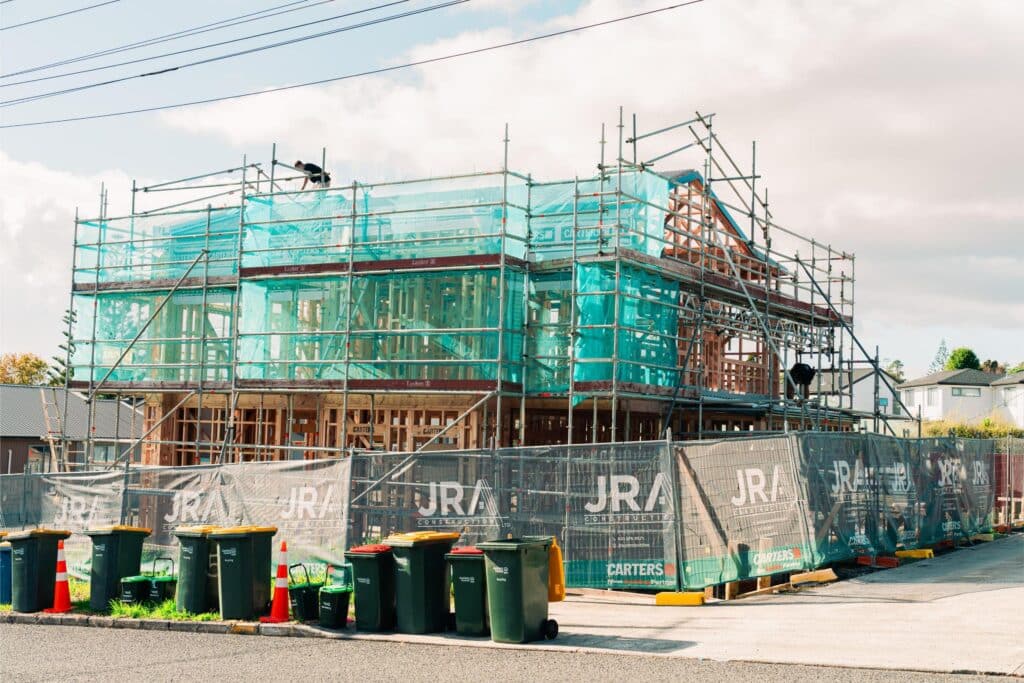
Project Snapshot: North Piha Road Renovation
To show you how a successful exterior design comes together, let’s look at our project on North Piha Road.
The Scenario:
Clients Sarah and John wanted to breathe new life into an “old-school” bach. Their brief was simple but challenging: create an easy, modern retreat that still felt at home in the rugged West Coast environment, while maximising indoor-outdoor living.
The Challenge:
Piha is a “high-risk” zone for exteriors. The combination of salt spray, wind, and coastal elements means that standard renovation methods often fail. The existing structure required a full gut and rebuild to meet modern standards for warmth and durability.
The Solution:
Working with RJ Architecture, we didn’t just paint over the cracks; we executed a complete structural refresh.
- Design Flow: We added a targeted extension to improve functionality and opened up the living areas.
- Outdoor Living: The centrepiece of the exterior design was a large entertainer’s deck. This effectively doubled the usable living space and connected the modern interior with the coastal surroundings.
- Finishes: We utilised high-durability materials suitable for the coastal zone, ensuring the “bach” character was retained without the maintenance headaches of the past.
The Result:
A home that balances the nostalgia of a classic bach with the reliability of a new build. By getting the exterior design right—focusing on the deck and the flow—we transformed a tired structure into a modern sanctuary.
Common Questions About Custom Exterior Design
Generally, building out is cheaper per square metre because you avoid the costs of scaffolding, removing the existing roof, and strengthening the lower floor structure.
However, on a steep slope, this flips. If “building out” requires massive retaining walls and deep piles, “building up” may become the cheaper option. We need to assess your specific site to answer this accurately.
Yes, dark colours (Black, Ironsand) absorb significant heat from the sun. This can cause timber to cup and warp. It also puts stress on the paint.
If you want a dark exterior, we recommend using materials that are stable, such as a vertical metal profile or specific heat-resistant paints (CoolColour technology). You must also ensure your wall insulation and thermal breaks are sufficient to stop that heat transferring inside.
It depends on the scope. For a “pop-top” (adding a second storey), the answer is usually no. Taking the roof off exposes the home to weather and safety risks. For a ground-floor extension, it is often possible to live in the main house, provided you can tolerate dust, noise, and tradespeople on site at 7am.
From the initial concept to having a Building Consent in hand, you should allow 3–6 months. This includes time for the Geotechnical Report, structural engineering design, and Council processing times (which can take 20 working days or much longer if they request further information).
Conclusion
A successful custom home exterior design is a balancing act. You must balance the Dream (Aesthetics) with the Land (Slope) and the Future (Durability).
Many homeowners try to rush this phase, only to find their project halted by a budget blowout or a rejected consent.
Remember: The cost of building rarely goes down. Materials and council fees increase annually. The most expensive thing you can do is spend months designing a home that you cannot afford to build.
You have a vision for your home, but the site constraints and council rules can make that vision blurry. Stop guessing about slopes, setbacks, and square metre rates.
Book a free consultation with JRA Construction today. Let’s look at your land and give you a straight answer on what is actually buildable.
