
Which renovation adds the most value depends on your home’s condition, layout and the problem you want to solve. A kitchen, bathroom, extension or smaller refresh can improve daily life. Its resale effect depends on the property and market, not a universal percentage or a fixed ranking of renovation types.
Start by separating three goals: putting the home into sound condition, making it more useful for your household, and preparing it for sale. Those goals can lead to different scopes. Replacing a worn-out bathroom may be necessary even when a new kitchen would make a more noticeable change in photographs.
This guide helps you compare the work, the budget and the trade-offs. It uses completed JRA projects to explain physical scope, not to promise a sale price or report measured resale returns. Keep the value of living in a better home separate from the money you might recover when you sell.
The Reality Check: Construction Cost Is Not Resale Value
The construction budget pays for work: labour, materials, subcontractors, design, approvals and other agreed project costs. Resale value is what the property may sell for in its market. A well-built improvement can be useful without increasing the sale price by the amount it cost.
At JRA Construction, our in-house Quantity Surveyor supports construction cost planning. That is different from independent property valuation. A registered valuer can assess property value; local market advice can help you understand comparable homes and buyer expectations. Use that property-specific information alongside a scoped building estimate when resale is a major goal.
One hypothetical example shows the distinction. If work costs $80,000 and an independent assessment attributes $100,000 of added property value to it, the added-value-to-cost ratio would be 1.25. If the added value were $60,000 instead, it would be 0.75. These are arithmetic examples, not JRA outcomes or Auckland benchmarks. Finance, selling and holding costs would still affect the overall financial result.
Before comparing quotes, write down the outcome you need and what you could accept instead. An improved kitchen layout might be possible within the existing room. Creating the same layout through an extension introduces a different set of work, risks and decisions.
What should you assess before spending?
There is no dependable single price for an unspecified renovation. Room size, existing condition, access, design and specification change the scope. The table therefore compares cost drivers and questions to resolve, rather than presenting unsupported construction ranges or expected returns.
| Renovation type | What changes the construction scope | What to assess before spending |
|---|---|---|
| Kitchen renovation | Keeping or moving services, cabinetry, appliances, structural changes and finishes | Is the problem condition, storage or layout? Compare a targeted refresh with replacement. |
| Bathroom renovation | Plumbing access, waterproofing, ventilation, fixtures and the existing structure | Would repairing the existing room meet the need, or is another bathroom genuinely useful? |
| Home extension | New floor area, foundations, structure, roof connections, access and approvals | Compare extra space with a better arrangement of the existing footprint. |
| Outdoor living and landscaping | Levels, drainage, structure, access, materials and maintenance | Identify how the space will be used and whether a simpler option would work. |
| Insulation, heating and condition work | Existing performance, access, moisture issues and the appropriate specification | Establish what the home needs for condition and comfort before choosing the product. |
| Cosmetic refresh | Surface preparation, repairs, room coverage, flooring and lighting | Separate necessary repair from presentation work and avoid covering up an unresolved defect. |
Plan your renovation budget: Use our Auckland Building Cost Calculator as an initial planning tool. Its preliminary range is not a quote for your home. Existing structure, site conditions, selections and scope still need assessment before a project-specific price can be agreed.
1. Kitchen Renovations: Assess Layout, Condition and Specification
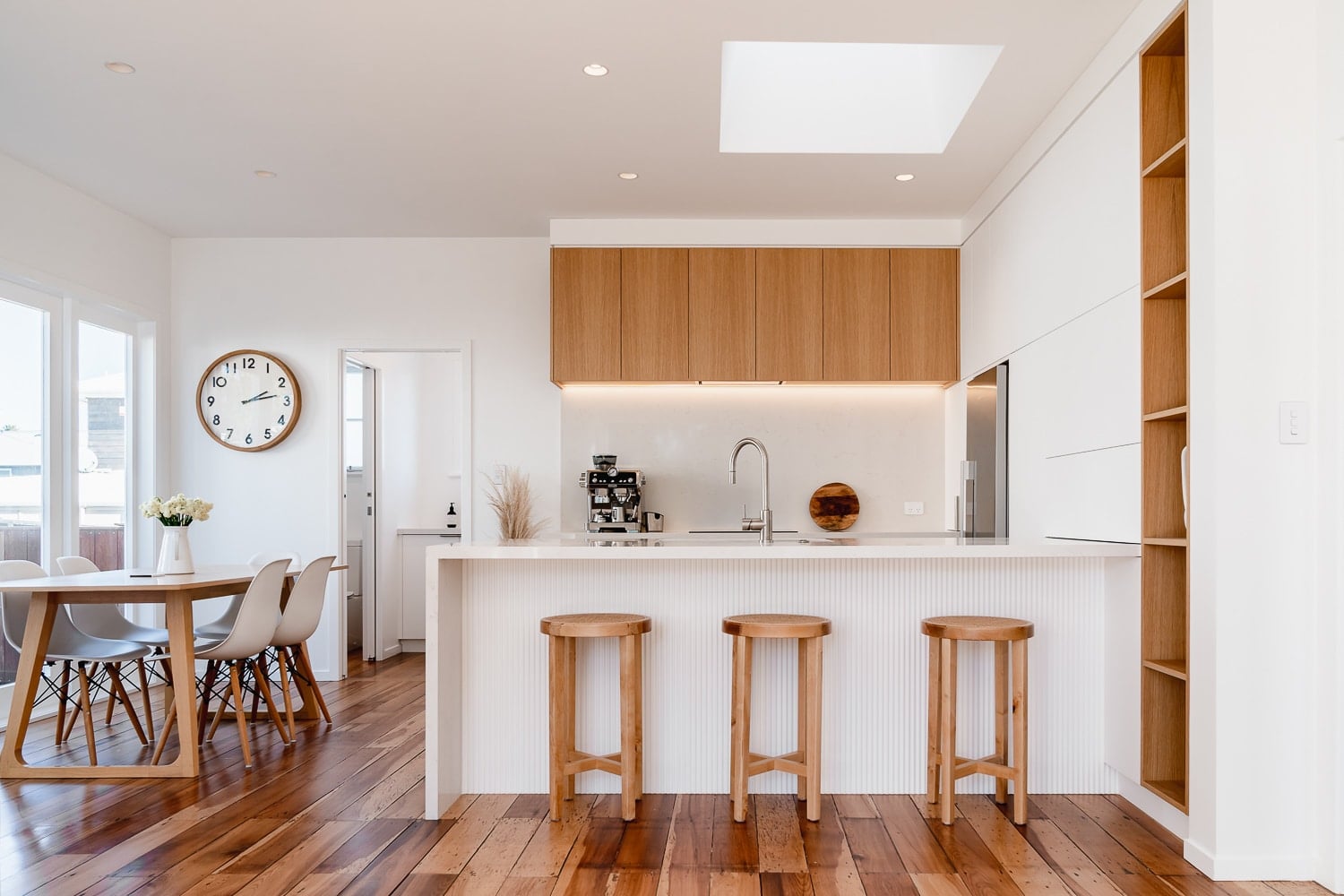
Assess whether the kitchen needs repairs, a better layout or replacement. A targeted refresh and a full renovation solve different problems. Replacing serviceable cabinets purely for a different colour is a different decision from fixing damaged cabinetry or creating safe, practical circulation.
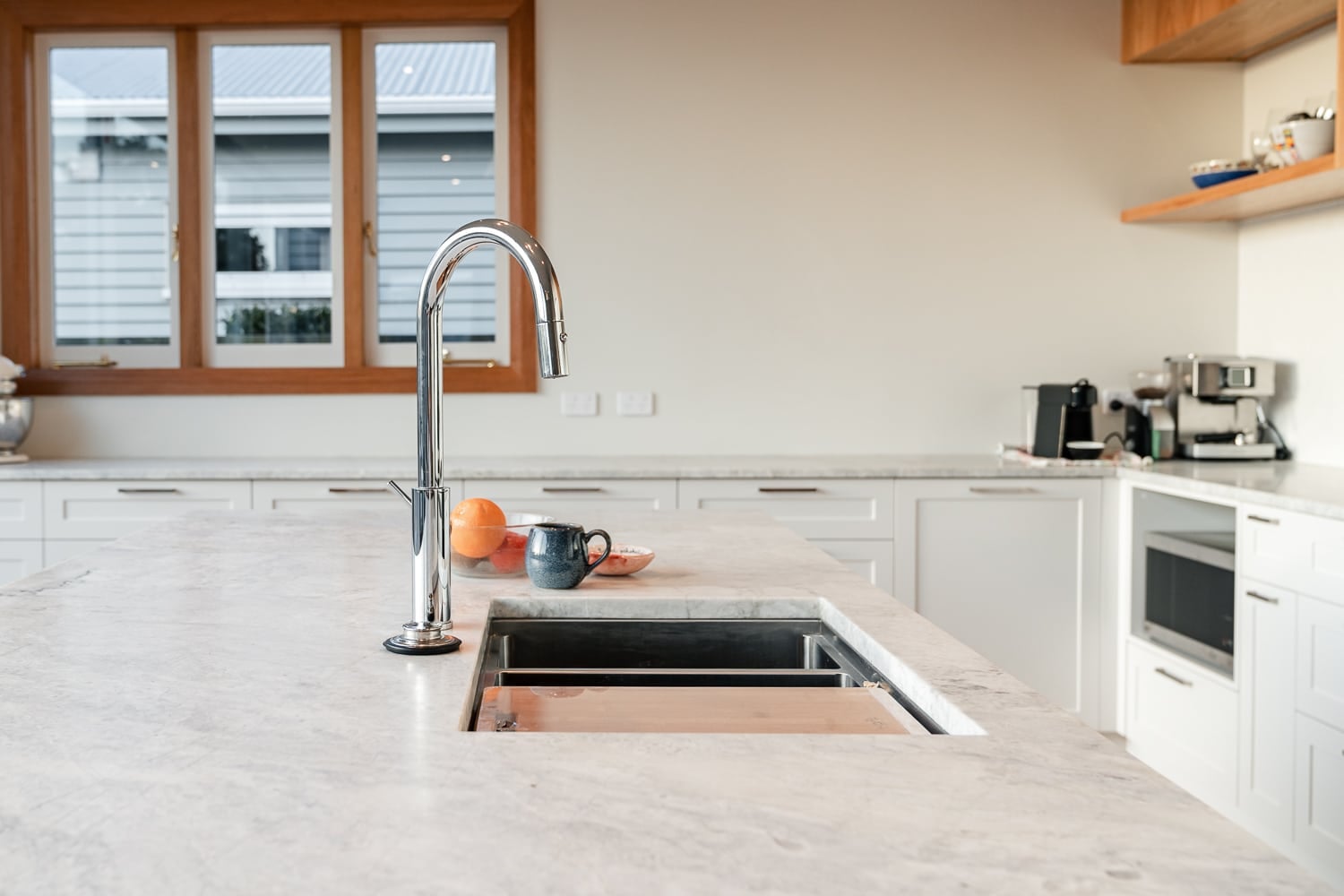
What affects the budget: List the cabinetry, benchtops, appliances, flooring, lighting, plumbing and electrical work you want included. Identify whether walls or services would move. A quote for new cabinet fronts is not comparable with one for a new layout, replacement cabinetry and structural alterations.
Draw the working arrangement before choosing finishes. Check where people will cook, load the dishwasher, put groceries and move through the room. Consider appliance-door clearances and storage access alongside appearance. Those details make the scope meaningful even before a construction price is available.
What to assess for resale: Compare the proposed specification with the rest of the home and similar local properties. An expensive kitchen does not automatically create an equivalent sale-price increase. Keep a list of essentials and optional upgrades so you can reduce the scope without losing the reason for doing the work.
Match the specification to your needs and budget. Our kitchen renovation service is a starting point for discussing the building work, whether you are keeping the existing room or considering a larger change.
2. Bathroom Renovations: Assess Function and Condition
Look at the bathroom’s condition, layout, ventilation and practicality. A room can look tired but still function well, or look presentable while hiding moisture concerns. Establish the problem before deciding whether fixtures, surfaces or the whole room need attention.
What affects the budget: Define the waterproofing, tiling, fittings, vanity, shower, toilet, lighting, ventilation and plumbing work. Ask what inspection or investigation is needed to understand the existing structure. Keeping fittings in place and relocating them are different scopes, even when the finished rooms look similar.
For an additional bathroom or ensuite, consider the space it takes from bedrooms, storage or circulation. Check plumbing access and how the new room connects with the rest of the home. More bathrooms are not automatically better if the arrangement makes another room difficult to use.
What to assess for resale: Consider whether the proposed bathroom arrangement suits the home’s likely occupants. An extra bathroom does not guarantee a listing-category change or a particular premium. Compare improving the existing room with adding another before committing to the larger option.
Choose finishes for durability, maintenance and the way the room will be used. Read more about our bathroom renovation approach before defining the scope you want priced.
3. Home Extensions: Compare Extra Space With Better Use of Space
An extension can provide more usable space, but first identify what the home lacks. Is it a bedroom, a workable family living area, storage or a connection to the garden? Extra floor area is not a complete answer if the resulting layout still has the same problem.
What affects the budget: The new structure must connect with the existing home. Foundations, roof form, structural alterations, access, services and any consent requirements all influence the work. A ground-floor extension and an upper-storey addition require separate assessments, not a price comparison based on floor area alone.
Compare an extension with reconfiguring the existing footprint. Think about the space lost to circulation, the effect on daylight and the outdoor area left afterwards. If you are staying, test the layout against your daily routines rather than designing only for a possible future buyer.
What to assess for resale: Consider the completed home as a whole, including its site and outdoor space. More floor area does not establish that the construction cost will be recovered at sale. Check that the proposed scope is proportionate to the problem it solves.
Our in-house quantity surveying supports project cost planning. Review the quotation’s clarifications and assumptions for consent-related costs and outstanding information. Identify the investigations and design decisions needed before treating an early estimate as a contract price.
4. Outdoor Living and Landscaping: Start With Use and Upkeep
Consider how outdoor space connects with the home and how you will use it. Better access, privacy and a practical layout can be worthwhile goals whether you plan to stay or sell. A covered area, a deck and a landscaped garden are not interchangeable projects.
What affects the budget: Levels, drainage, access, structural requirements and materials determine the work. Define what sits within the building scope and what is separate landscaping. Include the interface with doors, existing walls and stormwater rather than pricing the visible surface alone.
Compare a simple improvement with a larger outdoor project. A practical seating area may meet your needs without an outdoor kitchen. Conversely, a larger project may be justified by the way your household uses the home, even when resale is not its main purpose.
What to assess for resale: Usable space and manageable upkeep are useful comparison points, not a return formula. Consider how the area works in different weather and how much garden or parking remains. Do not assume a covered deck will add more value than it costs.
Ask for product-specific maintenance guidance when comparing timber, composite materials and finishes. Exposure, installation and the selected product affect upkeep. Build that maintenance commitment into your decision instead of relying on a universal service interval or a promise of maintenance-free outdoor space.
5. Insulation, Heating and Weathertightness: Assess Condition First
Condition and comfort are separate from resale calculations. If the home has moisture, heating or ventilation concerns, establish their cause and the appropriate work before choosing decorative finishes. Painting over a problem is not the same as resolving it.
What affects the budget: Access to the roof or subfloor, the existing construction, moisture sources and the intended system all matter. Heating and insulation work should be scoped for the home. Weathertightness remediation is a different investigation and construction exercise, not another item in a simple cosmetic package.
For a rental property, check the current Healthy Homes requirements and any applicable exemptions. For your own home, consider comfort and running costs alongside the building work. Neither compliance work nor a comfort improvement establishes a fixed resale uplift or a predictable payback period.
Where condition is uncertain, agree what needs inspection and what remains an allowance. Compare quotes on the same information. A lower initial figure may simply leave more unresolved work outside the price, so make those differences visible before choosing a scope.
6. Cosmetic Refreshes: Separate Repairs From Presentation
Paint, flooring and lighting can improve presentation without changing the home’s structure. Start with repairs and targeted work that addresses the actual condition. A smaller budget is not proof of a higher return, and a refresh should not be assumed to pay for itself.
What affects the budget: Surface preparation, existing damage, room coverage, access and material choices define the job. Repainting a sound surface differs from repairing damaged linings first. Replacing flooring may expose work that could not be assessed from a photograph.
Decide what should be kept, repaired, replaced or deferred. Consistent finishes may be more useful than one expensive feature beside unfinished work. If selling, compare essential repairs and presentation with the disruption of a larger renovation; if staying, prioritise improvements you will actually use.
Real Project Case Studies (JRA Construction Portfolio)
These two completed JRA projects illustrate renovation and extension scope, not measured value uplift or achieved resale returns.
Case Study 1: The Award-Winning Kitchen and Living Extension
- Project link: Fir Street, Waterview
- Recognition: 2023 Master Builders House of the Year Auckland / Northland / Coromandel Regional Gold Award, Regional Category Winner (Renovation up to $750,000) and National Top 100 (the dollar amount is an award category, not this project’s cost)
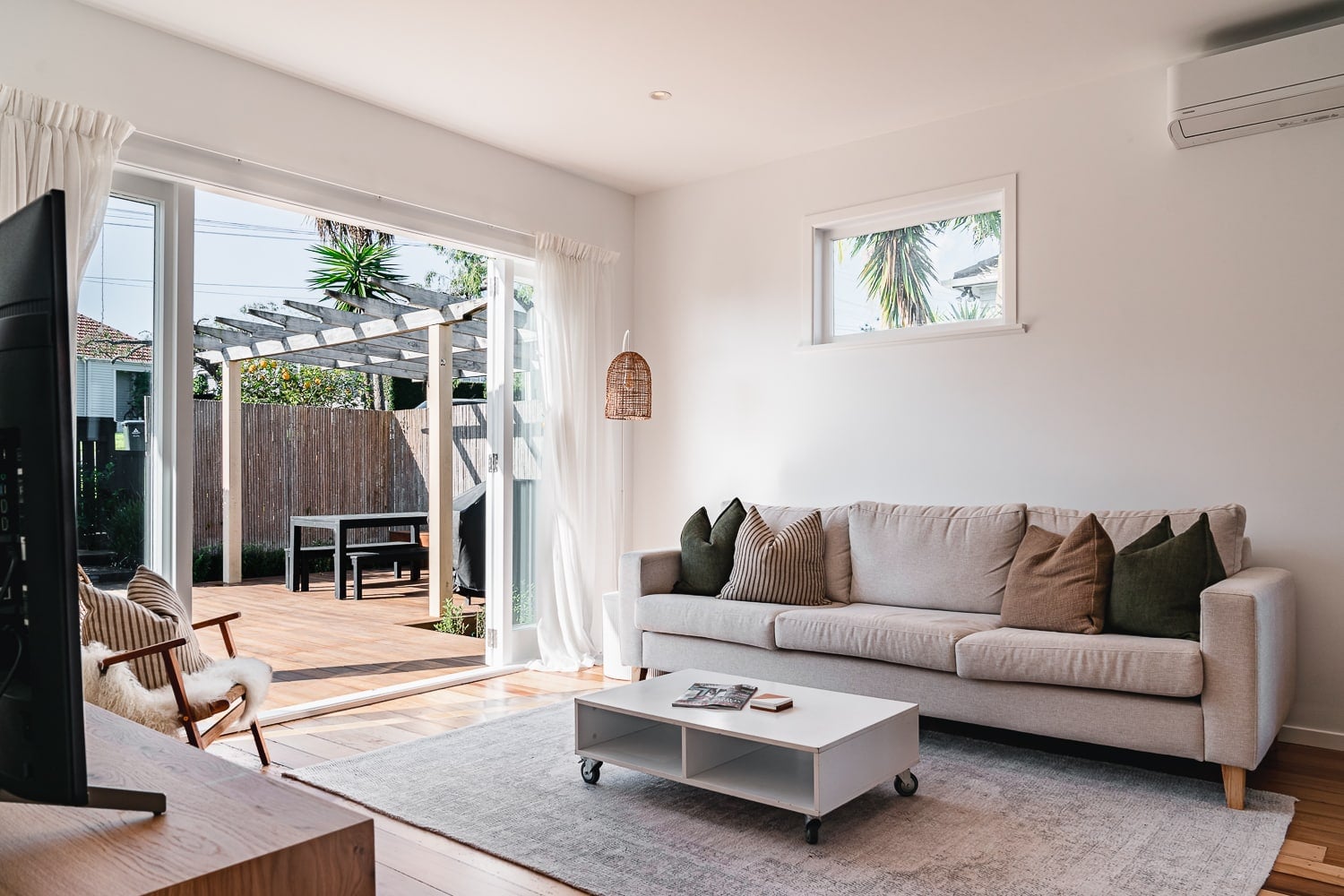
- The scope: Working with Hoxha Bailey Architects, we extended and renovated the living area to create a more open-plan layout, with a new kitchen, a refreshed living and dining area, and a stronger connection between the indoor living spaces and the outdoors.
- The Reality: The renovation and extension created a new kitchen and refreshed living and dining areas, improving flow and the connection to the outdoors.
Case Study 2: The Villa Kitchen, Ensuite and Bathroom Upgrade
- Project link: Westminster Road, Balmoral
- The scope: Renovation and rear extension of a classic Balmoral villa, designed by Spooner Architectural. The work included a new kitchen, dining and living area at the rear, a new master ensuite, a new main bathroom, refreshed bedrooms and hallway, and large sliding doors to the rear deck and backyard.
- The Reality: This project combined a new kitchen, an added ensuite and an upgraded main bathroom. The rear extension connects the new living spaces with the deck and backyard while retaining the villa’s character.
Understanding Comparable Property Values
Comparable homes can help you test a renovation idea, but a sale price is not a guaranteed ceiling for your own property. Location, land, size, condition and sale timing all affect whether another home is a useful comparison. Separate asking prices from completed sales.
How much renovation can your property support?
A property-value gap is not a spending allowance. A renovated home nearby may have a different section, outlook, floor area or condition. Copying its finish does not mean your home will sell for the same amount. Use genuinely comparable evidence before treating a possible sale-price difference as financial headroom.
| Decision question | What to check |
|---|---|
| What is the home like now? | Record condition, layout and unresolved repairs. |
| What would the proposed work change? | Identify usable space, specification and any trade-offs. |
| What is the complete project budget? | Include relevant design, construction, approvals and other project costs. |
| Are the sale comparisons genuinely similar? | Check property characteristics and the timing of sales. |
| What if the resale effect is smaller? | Decide whether the work still suits your household and finances. |
Keep your budget tied to what you can afford, not only to an optimistic future valuation. Allow for decisions that remain unresolved and check how the project would affect your sale timing. A renovation can be worthwhile for your own use without being a short-term financial investment.
Renovation Sequencing: What Should You Do First?
Choose the sequence after assessing the home’s condition, your budget and whether you intend to stay or sell. Raise structural, moisture and services concerns with the appropriate professionals before prioritising presentation alone. Work that will be concealed later deserves attention before new finishes are installed.
- 1Establish condition and scope. Identify what needs investigation and which decisions depend on it.
- 2Compare options. Test a repair, targeted refresh and larger renovation against the same household goal.
- 3Resolve dependencies. Check whether structural or services work needs to happen before cabinetry, flooring or decoration.
- 4Agree the price basis. Separate confirmed work, allowances, exclusions and decisions still to be made.
- 5Plan disruption. Consider access, temporary facilities and the order rooms will become usable again.
For sale preparation, weigh essential repairs and targeted presentation against the cost and delay of major work. For your own use, consider which changes would improve daily life. There is no single resale-return order that fits every Auckland home. The Real Estate Authority’s preparing your property for sale guidance is a useful starting point for the sale-preparation decision.
Consent and Building Code Considerations
Confirm the consent position before finalising the renovation scope. Structural changes, extensions and some plumbing or drainage work may require building consent. Some repair, replacement and other work can be exempt, but the exemption conditions matter. Do not decide from a room label alone.
For example, repainting a kitchen is not the same scope as removing a load-bearing wall. Window, cladding and plumbing work also have specific rules and exemptions. Check the actual proposed work rather than assuming that every change to the building envelope needs consent or that every like-for-like replacement is exempt.
Use the current MBIE guidance on building work that does not need consent with your designer or relevant professional. Exempt work must still meet applicable Building Code requirements. Resource consent is a separate question where planning rules affect the proposal.
Include any applicable design, consent and inspection costs in the project budget before committing. Confirm who organises the application and who pays the fees. A construction-cost example cannot establish either the approval needed for your home or whether the renovation will be a good resale investment.
For more budgeting detail, read our guide to creating a realistic renovation budget in Auckland.
Renovations to Assess Carefully Before Spending for Resale
Do not assume an improvement you would enjoy will be valued equally by a future buyer. Compare the scope with alternatives for the property, including doing less work. These are trade-offs to assess, not a list of projects that always lose money.
Do swimming pools add value in Auckland?
Consider installation, maintenance, safety and ongoing costs alongside how you would use a pool. Check the effect on the rest of the outdoor area. Buyer preferences and the property differ, so neither a guaranteed premium nor a fixed loss should be assumed.
Can you over-specify for your suburb?
A more expensive finish does not automatically produce a matching sale-price increase. Compare premium selections with the home’s overall condition and the rest of the scope. Decide which items matter to you and which could be simplified without losing the purpose of the renovation.
Do garage conversions add value?
Assess the usefulness of the new room alongside parking, storage and applicable approvals. Check access and how the room connects with the home. Losing a garage is a real trade-off even when the conversion adds usable internal space; it is not a universal resale calculation.
What about highly personalised features?
Decide whether a cinema, wine cellar or specialist room is for your enjoyment or resale. Consider ongoing use and how easily the space could serve another purpose. Do not depend on recovering the construction cost to justify a feature that only makes sense for your own household.
How JRA Helps You Plan a Renovation
JRA Construction provides Auckland home renovations and extensions, including kitchen and bathroom renovation services. We can discuss the building scope and pricing basis before you commit to construction. You can see more completed renovation and extension work on our projects page.
Compare a cosmetic refresh with a larger renovation against your needs, budget and property-specific market advice before committing to drawings or a bigger scope.
Every renovation starts with an obligation-free initial contact and a site meeting to understand your property and goals. Our estimate of costs tests the scope against your budget before detailed design, then a quotation lists our clarifications and assumptions to explain the basis of the proposed price. Contract agreements, the construction phase and a walk-through at completion follow. JRA offers fixed-price contracts for the agreed scope, subject to the contract terms, and our Build with Confidence guarantee. Our how it works page explains each step.
Proper planning before committing to construction helps you understand the project scope, costs and risks before work starts. Bring your priorities, available plans and questions about what to keep or change to that discussion. For a useful starting point, separate the household outcome from the specification choices that could achieve it.
If you are planning a renovation in Auckland, request an estimate from JRA to discuss the building scope and next steps. You can also read our complete guide to Auckland home renovations or visit the JRA Construction homepage to meet our team.
Frequently Asked Questions
Which renovation adds the most value in Auckland?
The best choice depends on your home’s condition, layout and goals. Compare what a kitchen, bathroom, extension or smaller refresh would actually solve, then assess the complete budget and resale context. Useful extra space and a more expensive specification are not the same thing, and no renovation type is a universal financial winner.
How should I budget for a kitchen renovation in Auckland?
Start with a defined scope rather than a generic room price. List what stays, what changes, whether services or walls move, and the cabinetry, appliances and finishes required. Compare quotes on that same basis, including preparation, exclusions and allowances. A targeted refresh and a full layout change should not be treated as equivalent work.
Is adding a bathroom worth it for resale?
An extra bathroom may improve usefulness, but its resale effect is property-specific. Consider who will use it, the space it takes and the work needed for plumbing and ventilation. Compare adding a room with improving the existing bathroom. An ensuite does not by itself guarantee a new search category, a premium or recovery of the construction cost.
Do home extensions add value?
An extension can add useful space, but more floor area is not a guaranteed financial return. Compare the resulting layout, site use and total project budget with making better use of the existing home. The question is whether the extension solves the right problem at a cost that fits your goals, not whether it meets a standard recovery percentage.
Should I renovate before selling my Auckland home?
Compare essential repairs and smaller presentation work with a major renovation, including disruption and sale timing. Resolve known condition issues rather than covering them up. A property can be presented honestly without replacing every room. Decide whether the proposed work is justified for your circumstances instead of assuming any option will pay for itself.
What renovations should I assess carefully for resale?
Look closely at expensive specifications, lost parking, highly personalised rooms and work that leaves condition concerns unresolved. Compare each with a simpler alternative. Separate personal enjoyment from expected sale proceeds, and include ongoing maintenance in the decision. A project can be right for your household without being a dependable way to increase resale profit.